 Español
 Français
Rabbit Unit






About the Unit
The Rabbit Unit is designed for practical training and research in commercial rabbit production and animal welfare. It is made up of a building divided into two independent areas, one for teaching and the other for research, both equipped with different housing systems commonly used in industrial rabbit production: group pens and multi-purpose flat-deck cage systems. The unit also has dedicated areas for clinical examination, animal handling, sample collection and routine husbandry procedures, providing students a learning environment aligned with real commercial rabbit production conditions and the requirements of veterinary research.
Teaching and Research
The Rabbit Unit building is divided into two independent areas, one for teaching and the other for research.
Teaching area
The teaching area includes a rabbit production unit, housing rabbits under conditions that simulate a commercial farm. It uses the two most widely used housing systems in industrial rabbit production:
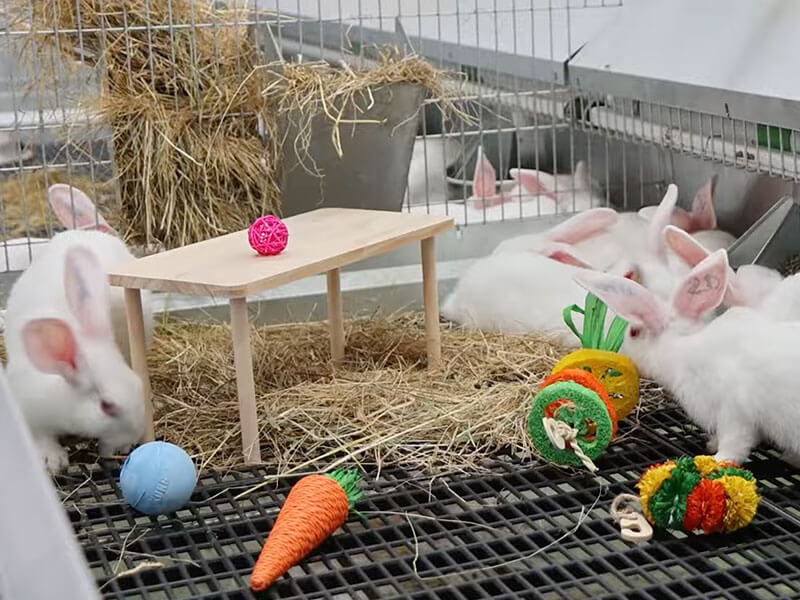
- Group pens, (1 module with 4 compartments) enabling animals to be grouped together. These include automatic feeders and drinkers. This collective housing system is used for groups of kits, replacement animals up to puberty and breeding females on a part-time basis.
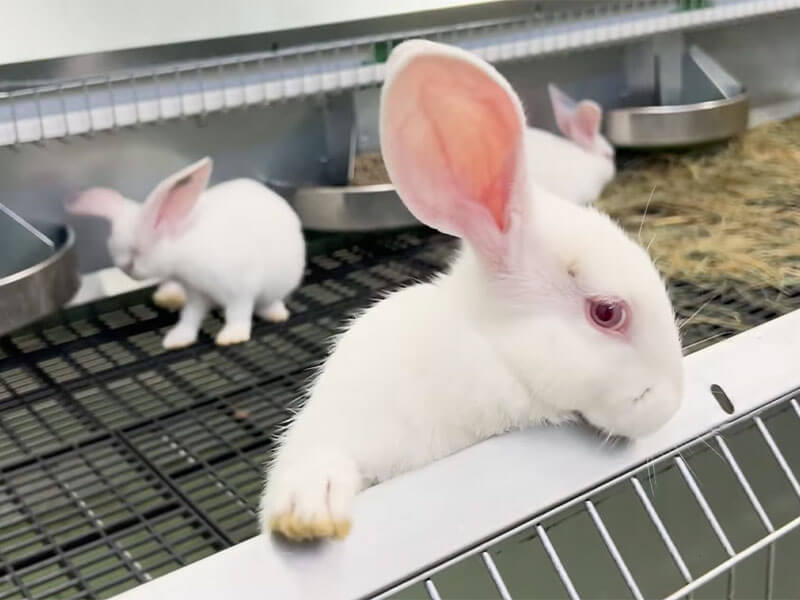
- Enriched multi-purpose cages arranged in a flat-deck system (2 modules x 4 cages). Each cage is equipped with an automatic drinker, a hopper for manual feeding and a hay rack. All cages can be adapted for use with breeding females (by adding a nest box), fattening, breeding males or replacement animals.
This teaching area also has a work table for clinical examination procedures, sample collection, weighing animals, etc.
Research area
This area houses rabbits for use in research. The rabbits are involved in different experimental procedures as part of projects that have been authorized by the University’s animal experimentation ethics committee, the OEBA. This is in accordance with Spanish legislation (Royal Decree 53/2013, regarding animal experimentation for teaching and other scientific purposes, which requires the University to set up such a committee, referred to as the órgano encargado del bienestar animal (OEBA)) and Directive 2010/63/EU.
This area possesses enriched multi-purpose cages arranged in a flat-deck system (1 module x 16 cages) enabling rabbits to be housed from weaning onwards. Each cage has an automatic drinker, a hopper for manual feeding and a hay rack for roughage provision. This area also possesses a separate workroom where basic procedures such as sample collection and animal handling can be carried out. It has workbenches and storage areas for consumable materials and an adjoining storage room for additional consumables.
- Pens, (1 module with 4 compartments) enabling animals to be grouped together. These include automatic feeders and drinkers. This collective housing system is used for groups of kits, replacement animals up to puberty and breeding females on a part-time basis.
- Enriched multi-purpose cages arranged in a flat-deck system (2 modules x 4 cages). Each cage is equipped with an automatic drinker, a hopper for manual feeding and a hay rack. All cages can be adapted for use with breeding females (by adding a nest box), fattening, breeding males or replacement animals.
This teaching area also has a work table for clinical examination procedures, sample collection, weighing animals, etc.